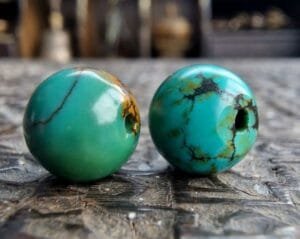
1. Turquoise: The “Sky Stone” Mineral
Turquoise is a hydrous phosphate of copper and aluminum. Its iconic color is a chemical dance: Copper provides the vivid blues, while Iron or Zinc shifts the stone toward the earthy greens favored in Tibetan culture. Unlike many gemstones, turquoise is opaque and “cryptocrystalline,” meaning its crystals are so small they can only be seen under a microscope.
2. The Dark Side of the Market: Imitations & “Dyeing”
As a collector, you must beware of “Trade Names” that mask lower-value materials.
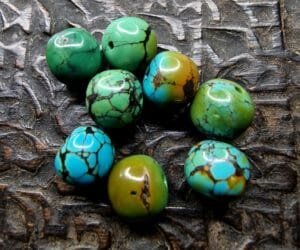
The Iolite Trap: Iolite is a beautiful violet-blue mineral, but lower-grade, pale iolite is often dyed teal and sold as “Natural Turquoise.” Because iolite is harder (7–7.5 on the Mohs scale) than turquoise (5–6), it can even pass a basic scratch test, making it a dangerous imitation.
Howlite & Magnesite: These are the most common fakes. They are naturally white with grey veins but absorb dye perfectly to mimic the “spiderweb” matrix of premium turquoise
3. Understanding Treatments: Stabilized vs. Enhanced
Not all treated turquoise is “fake,” but transparency on pricing is key:
Natural Turquoise: Untreated and rare. Only the hardest 10% of mined turquoise is stable enough to be cut without chemicals.
Stabilized Turquoise: The stone is infused with clear epoxy resin under pressure. This fills the pores, preventing the stone from changing color due to skin oils and making it durable for Turquoise Beads.
Enhanced (Zachery Process): An electrochemical treatment that improves color and hardness without adding resins. It is harder to detect but should always be disclosed.
4. Famous Varieties Around the Globe
While we specialize in the Himalayas, the world of turquoise is vast:
Sleeping Beauty (Arizona): Famous for a pure “Robin’s Egg” blue with no matrix.
Kingman (Arizona): Known for its bright blue and black “water web” matrix.
Hubei (China): Produces incredible “Spiderweb” patterns that rival the best American mines.
Tibetan Turquoise: Distinctly green-blue with a heavy, dark matrix. It is prized for its “waxy” luster and spiritual protection.
5. The Value of Authenticity: Pricing in 2026
Pricing is determined by rarity, origin, and age.
New Natural Turquoise: Expect to pay from $10 USD per gram for high-quality, untreated stones. This is the gold standard for modern Turquoise Necklaces.
Antique Tibetan Turquoise: Due to its rarity and historical “patina,” genuine antique beads start at $30 USD per gram and can go much higher. These stones have “healed” over decades of use in Tibetan Malas, absorbing the energy and oils of generations.
Why Shop With Us?
At Antiques Himalaya, we bridge the gap between mineralogy and craftsmanship. Whether you are looking for a strand of stabilized beads for a new project or a museum-grade antique mala, we provide the provenance and quality that modern collectors demand.
To make your post rank well and drive sales, you need exact-match and partial-match anchor text for your links. This tells Google exactly what the destination page is about.
Here are your two paragraphs with the requested titles and optimized links:
The Heritage of Tibetan Turquoise
The spiritual and cultural heart of the Himalayas is reflected in the unique character of its gemstones. Unlike the sky-blue varieties found in the West, CLICK HERE Tibetan Turquoise is celebrated for its deep teals and organic, mossy greens. These stones are often passed down through families, becoming more beautiful as they absorb the history and oils of the wearer. To understand why this specific origin commands such respect among collectors, you can explore the full history and mineralogy of these high-altitude treasures in our dedicated guide.
Investing in Ancient Craftsmanship
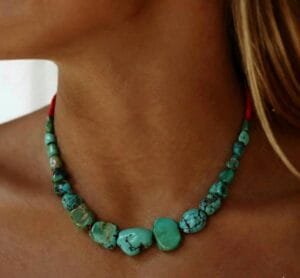
For those seeking more than just a mineral specimen, our collection offers a bridge to the past through wearable art. CLICK HERE Ancient Tibetan Turquoise Necklace is more than a jewelry piece; it is a curated assembly of stones that have survived centuries. With antique beads valued at approximately $30 USD per gram, these pieces represent a significant investment in both material and history. Each bead shows the soft, asymmetrical wear around the drill holes that only occurs after generations of use, ensuring you are wearing a piece of genuine Himalayan provenance.
Turquoise Authenticity Checklist
Colour Profile: Look for varied blue-green shades. Pure, uniform “neon” blue is rare in nature and often indicates dye or synthetics.
Matrix Depth: Genuine matrix (the host rock) should be slightly recessed or flush with the stone, never sitting on top like paint.
The Luster Test: Authentic turquoise has a waxy to sub-vitreous luster. If it looks like shiny glass or cheap plastic, it likely is.
Weight & Temperature: Real stone feels cool to the touch and has a specific heft. Plastic imitations warm up quickly and feel “light.”
Drill Hole Inspection: For beads, check the entry point. If the color is white inside the hole, the stone has been surface-dyed.